
Running a Sex Offender Check in Yakima County
Start with the Yakima County sex offender gateway or the Washington Sex Offender Public Registry search. Both lead to Washington's public registry system. The county gateway adds local context and access to neighborhood alerts, while the statewide search supports a name or location query. A person search works best with both first and last name. A place search can use an address, city, ZIP code, county selection, and a radius control. The official materials do not expose the current radius choices in crawlable text, so no distance should be assumed before opening the live tool.
The WASOR entry page is another official route. The free Yakima County Sheriff, WA app also advertises a Sex Offenders module, along with tips and agency contacts. Search that exact app title in the device's store because the research did not confirm a stable store link. For a Yakima County address inside a city, the city police department monitors local registrants. The Yakima County Sheriff's Office handles unincorporated areas, places without a police department, and transient registrants within its jurisdiction.
Yakima County Registry Access Channels
Each official access route serves a different need. Use the Washington registry for a public name or proximity search. Use the Yakima County gateway for local notices and alert enrollment. Call the Yakima County Sheriff's Office registry information line at 509-574-2521 when a listing appears wrong, a Level I disclosure question requires lawful review, or the correct registration jurisdiction is unclear. The registration counter is at 1822 South 1st Street in Yakima. General sheriff public hours are weekdays from 9:30 a.m. to 4:30 p.m.
The local office does not replace a city police department's role. A registrant living within Yakima, Sunnyside, or Grandview city limits generally works with the responsible city police agency, while the sheriff covers unincorporated Yakima County and transient cases assigned to it. Information can be forwarded between agencies when a location changes. This division matters when reporting an address concern: the agency monitoring that address is the best first contact, though the registry's tip or correction control can route information to law enforcement.
A request for an existing sheriff agency record is separate from a correction tip. Use the YCSO public records portal when the goal is a releasable record held by the sheriff, subject to Washington disclosure limits. The public registry remains the proper channel for a profile search.
Note: Call 911 for an immediate threat; use the registry tip control or local agency line for nonemergency listing concerns.
Searching the Washington Sex Offender Public Registry
The Washington Association of Sheriffs and Police Chiefs operates the public registry system, and county sheriffs remain responsible for registration and local notification. The public interface offers two verified modes: Name and Location. It can show results as a map or list. It also includes an optional email-alert feature and a tip or correction path. Exact button labels, radius values, and required-field rules depend on the live, client-rendered interface and should be read there rather than inferred from another state's OffenderWatch site.
- Open the official registry and read its conditions of use. Continue only for lawful personal or community-safety purposes.
- Choose Name for a known person or Location for an address-based Yakima County search. Add only the fields you can verify.
- Review the map or list without treating a similar name as a match. Compare aliases, physical details, and the listed jurisdiction.
- Open the full public profile. Read the offense, risk status, address notation, compliance information, and agency contact together.
| Field Label | Type | Required | Notes |
|---|---|---|---|
| Name mode | Mode tab | Unspecified | Opens the person-name search. |
| First / Last Name | Text | Unspecified | Use known spelling and check aliases on a profile. |
| Location mode | Mode tab | Unspecified | Opens the geographic search. |
| Address / City / State / ZIP / County | Text and dropdown | Unspecified | Supports proximity and county filtering. |
| Radius | Dropdown | Unspecified | Available, but exact live values were not verified. |
| Map / List | Display control | No | Changes how geographic results are shown. |
| Email alert | Optional signup | No | Monitors qualifying moves near a chosen address. |
For the clearest result, begin narrowly and then widen the location search only if needed. A public list can omit most Level I registrants under Washington disclosure law, so an empty result has a limited meaning. Use the agency contact on a profile for verification, and call the Yakima County registry line when a lawful local question cannot be answered through the public fields.
Yakima County Registry Alerts
Email monitoring adds a practical layer to a one-time Yakima County registry check. The official tool lets a user choose an address and request notice when a qualifying Level II or Level III registrant moves nearby. An alert is a prompt to open the current profile, not proof that a person has violated a rule. Coverage follows Washington disclosure policy, so most Level I registrants will not trigger the same public notice. Address data can also change between checks, and the monitoring service cannot promise that every move appears at once.
For a search that may cross state lines, the U.S. Department of Justice provides the National Sex Offender Public Website. The national site queries participating jurisdictions, while Yakima County and Washington channels remain the better sources for local agency contacts, corrections, and alerts.
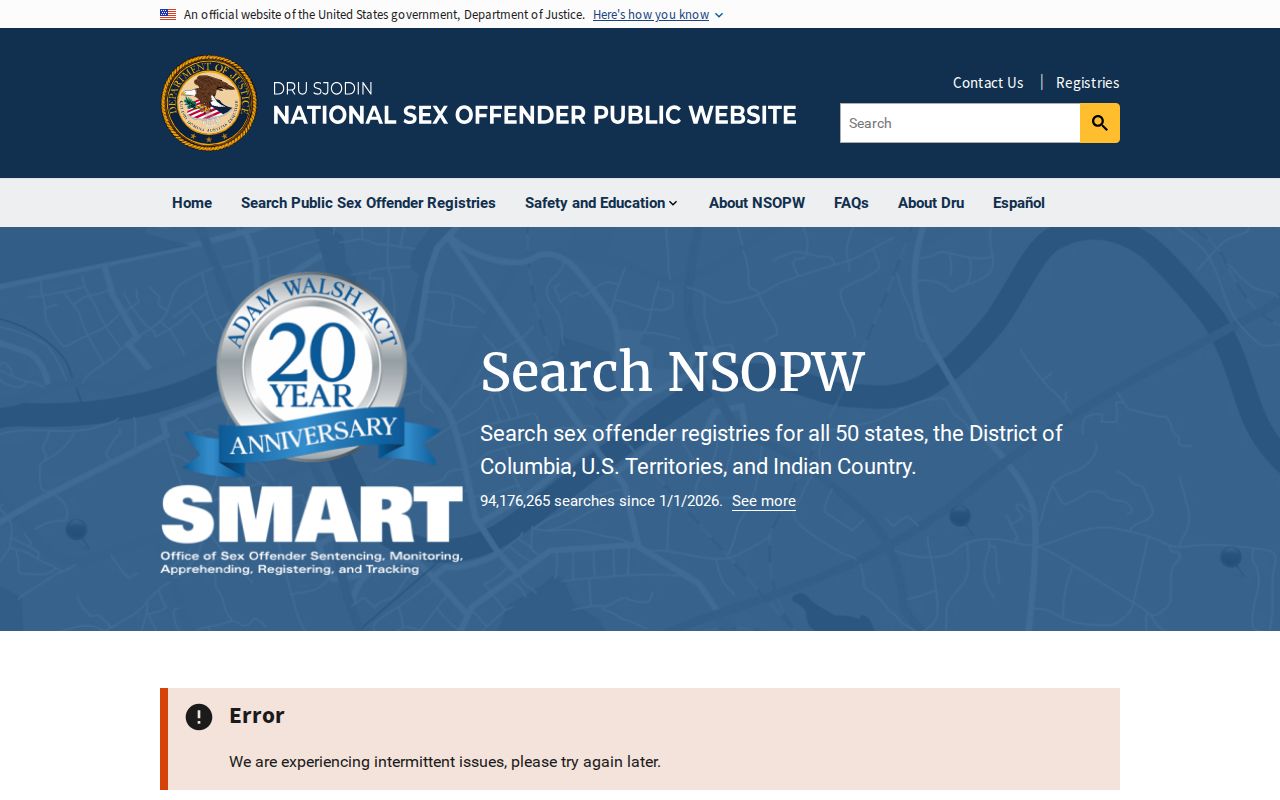
The national search is most useful when the relevant address history is not confined to Washington, then the local profile should be verified with the listed agency.
What a Registry Profile Shows
A Yakima County public profile combines identifying details, registration status, offense information, and an agency contact. It may show whether the record concerns an adult or juvenile matter when applicable. It can also include a notification narrative, compliance status, transient notation, conviction jurisdiction and date, permissible victim descriptors, and vehicles. The format warns that a listed person has served a sentence and is not necessarily wanted. It does not publish every detail held in a law enforcement file, and the profile alone does not prove a new offense.
| Name & Aliases | Primary name and known public aliases used to distinguish similar results. |
|---|---|
| Photo & Description | Photo plus sex, race, age or date of birth, height, weight, hair, eyes, and visible marks or tattoos. |
| Address Status | Registered address or a transient notation, subject to the profile's status and agency updates. |
| Offense Record | Public offense description, conviction jurisdiction and date, and related notification text. |
| Risk Level | Washington Level I, II, III, or unlevelled status used for disclosure decisions. |
| Registration Status | Compliance or transient information, agency contact, notification date, and any public caution. |
Read the record as a whole. A location can be a transient notation rather than a conventional home address. A vehicle or physical mark helps identification but does not by itself confirm that the person seen is the listed person. When a fact conflicts with direct knowledge, use the profile's correction or tip option and contact the monitoring agency.
Yakima County Registry Office Roles
The Yakima County registry page connects the public search with the sheriff's local information line. YCSO registers and monitors people in its assigned areas, handles transient registrants within its jurisdiction, and receives tips or corrections. City police departments take the corresponding role for addresses within their cities. That structure explains why the contact printed on one profile may differ from the Yakima County Sheriff's Office even when the search result appears on the same statewide system.
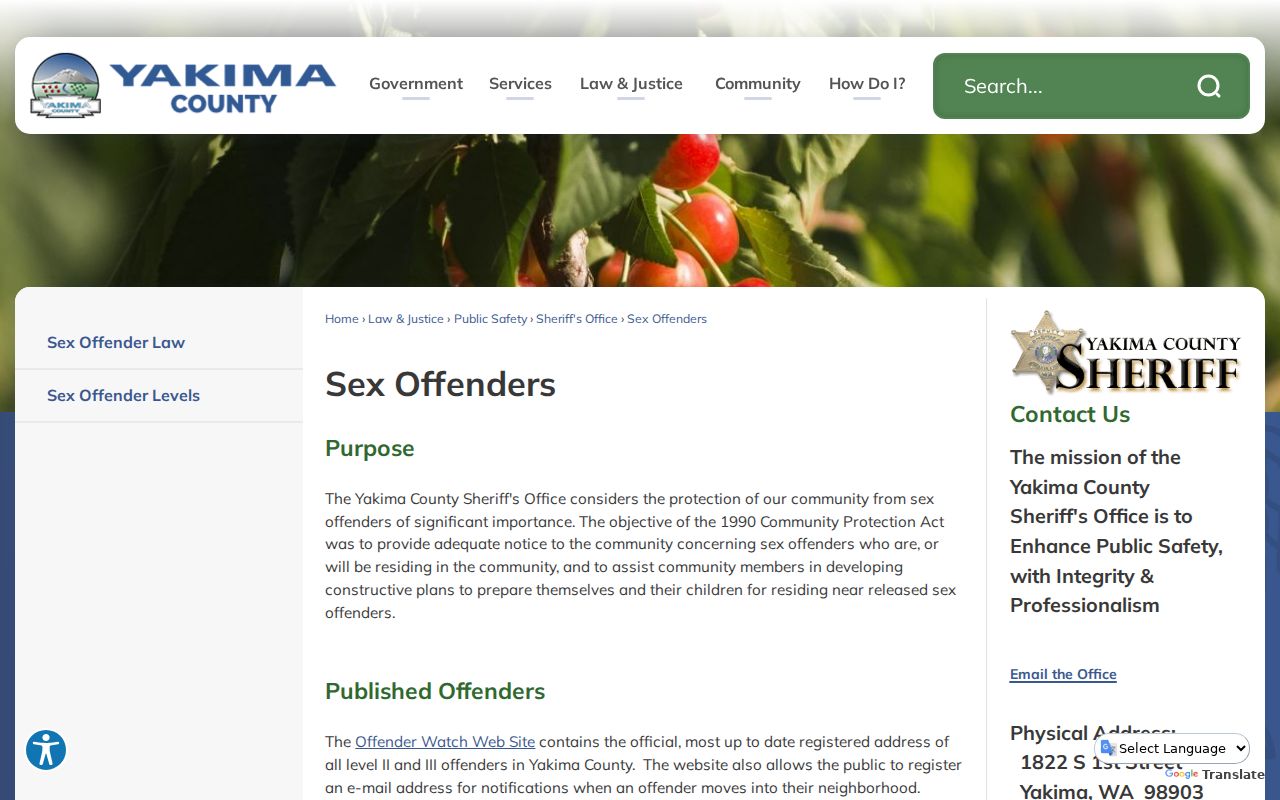
The county page is the best local handoff when a Washington registry result needs clarification, a lawful Level I inquiry, or follow-up about an unincorporated address.
A tip is not a public finding of noncompliance. Supply the specific profile, address concern, date, and observed fact to law enforcement, then let the responsible agency verify it. Do not confront the listed person or household. For a simple web error, the correction control and 509-574-2521 registry line give Yakima County staff a direct path to review the information.
Registration Requirements and Levels in Washington
Washington's Level I, II, and III labels describe assessed risk and the scope of public notification under RCW 4.24.550. They do not set the registration term. Registration duties arise under RCW 9A.44.130, while duration generally turns on offense class and the rules in RCW 9A.44.140. The source research did not verify one universal check-in frequency for each public risk level, so the table keeps verification tied to the applicable duty and agency instructions rather than inventing a schedule.
| Risk Level | Public Disclosure | Duration Relationship |
|---|---|---|
| Level I | Low assessed risk; ordinarily not public, subject to qualifying-request, transient, and out-of-compliance exceptions. | Not set by the level; offense class and statute control. |
| Level II | Moderate assessed risk; public or targeted notification applies. | Not set by the level; offense class and statute control. |
| Level III | High assessed risk; public-at-large notification is permitted. | Not set by the level; offense class and statute control. |
| Unlevelled | Level I disclosure rules apply while assessment remains pending. | Not set by the interim disclosure status. |
Most Level I registrants therefore do not appear in a routine public Yakima County search. Law enforcement may disclose information in the circumstances Washington law allows, including certain requests and public exceptions for transient or out-of-compliance status. A missing public profile does not prove that no registration duty exists.
Yakima County Registry Risk and Duration
The easiest mistake is to treat Washington risk levels as federal SORNA tiers. They answer different questions. Yakima County and city agencies use the Washington risk assessment to decide who receives public notice and how broad that notice may be. Under RCW 9A.44.140, registration duration generally follows the offense class and a statutory offense-free period in the community. A Level II label does not automatically mean a 15-year term, and a Level III label does not itself create lifetime registration.
- Class A
- Registration is generally indefinite unless the person is lawfully relieved.
- Class B
- The general period is 15 years after the statutory offense-free community period.
- Class C
- The general period is 10 years after the statutory offense-free community period.
Only the current statute and the responsible agency can resolve an individual registration term. Washington also has no blanket Yakima County school or park residence buffer supported by the research. A court order or supervision condition may restrict a specific person, but that must not be rewritten as a countywide rule for every registrant.
Yakima County Registry Residence Rules
A map pin near a school, park, or child-care site does not prove that the address is unlawful. The official Yakima County research did not identify a blanket countywide distance buffer that bars every registrant from living near those places. Washington registration and notification law should not be confused with an automatic local school-zone ban. Individual court orders, release terms, or supervision conditions can impose restrictions on a specific person, but those terms require verification through the responsible court or supervision agency.
Use the registry for the facts it actually publishes: the disclosed address or transient status, risk level, offense record, compliance information, and monitoring agency. If an address seems inconsistent with a known case condition, submit a factual tip to the listed agency. Do not infer a violation from distance alone, and do not use a map result as grounds for confrontation.
Lawful Use and Community Notification
The public registry supports personal safety planning and community awareness. Yakima County residents can review public profiles, enroll in location alerts, and report a concrete error to the agency that maintains the entry. Community notification may be targeted or public at large based on Washington's disclosure rules and assessed risk. The information must not be turned into a reason to confront, threaten, damage property, or encourage vigilante action. Use the profile to stay informed, confirm the listed agency, and share factual concerns with law enforcement.
Misuse can lead to prosecution: Yakima County and WASPC warn that registry data may not be used to threaten, harass, intimidate, vandalize, or commit violence. RCW 4.24.550 governs lawful public disclosure.
Accuracy matters as much as lawful use. Registration information can change, and the person shown has served the sentence described in the public notice. The profile is not a warrant result. If wanted status or an emergency is the real concern, contact law enforcement through the appropriate channel instead of drawing that conclusion from the registry.